Korus Ticket has been designed for distributors. It allows them to sell a wide range of tickets by integrating just a single API. Korus Ticket offers a unified ticketing system. Under the hood, the Korus Ticket is actually an aggregation of ticketing systems with a robust cache system organized around a set of entities.
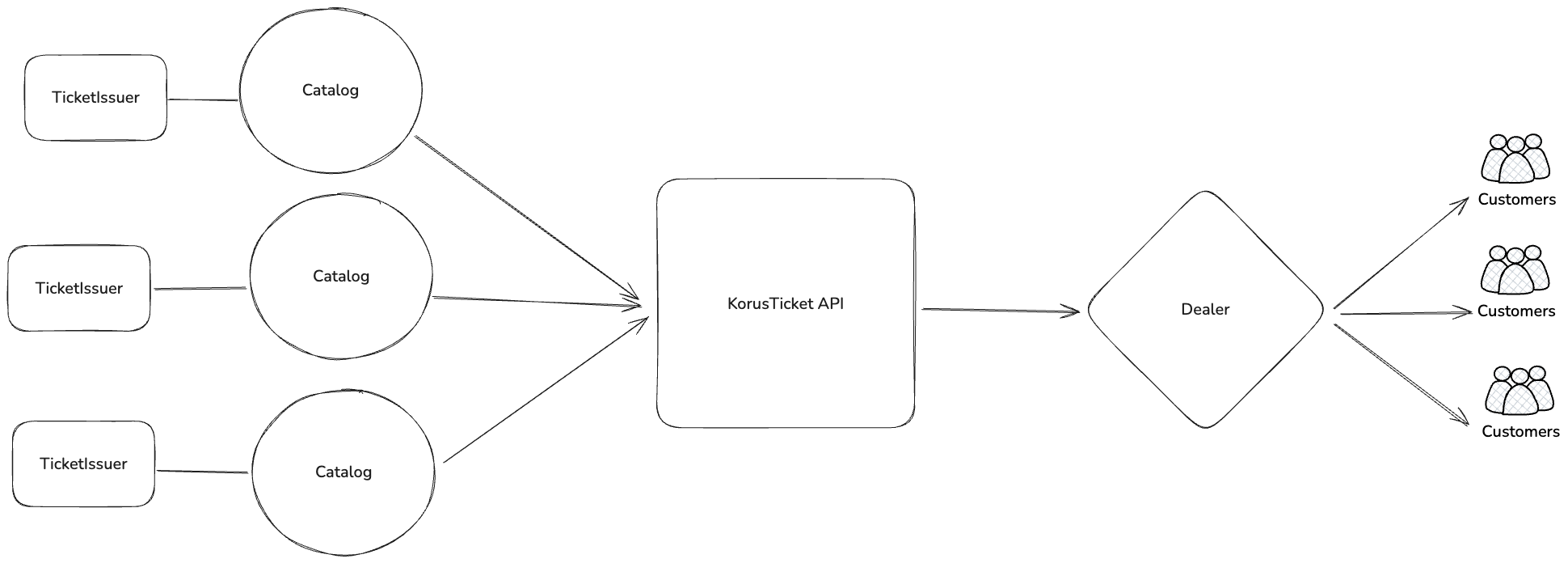
A ticket issuer is an entity responsible for managing and issuing tickets for an event, transport or any other service requiring a reservation.
A Catalog is the ticket issuer's collection of ProductBases. There is usually only one Catalog per TicketIssuer.
ProductBase are the main elements of a catalog. They allow grouping related products. They contain options with values that can be used to filter products.
A Product represents a unique version of a product base (e.g., a 3-day park entry in price_type adult). The price and availability of a product at a specific date are specified in the Offer object.
It is the price table of a product. Offers define the price and availability of a Product at a specific date.
OfferTickets are contained in an Offer. OfferTicket might allow all-day access or only a limited session time.
OfferTicketSession represents the time slot of an OfferTicket.
A reservation temporarily holds an Offer, guaranteeing its availability and price for a limited time in the ticket issuer's system.
The content of a reservation. Typically, items are the offers being reserved.
An Order is an actual booking in the ticket issuer's system.
The content booked. It contains the detailed price and the booked tickets.
The files associated with the Order. These are typically the customer's tickets for the event.